

TL;DR
Lisa Su engineered one of the most significant corporate turnarounds in modern semiconductor history. When she took over AMD in 2014, the company was technologically behind, financially distressed, and losing relevance to Intel and Nvidia. Su executed a decade-long rebuild anchored in high-performance computing, architectural discipline, ruthless capital allocation, and a culture of engineering excellence.
Her strategic bets — Zen architecture, chiplet design, EPYC’s data-center push, and the Xilinx acquisition — transformed AMD from a near-bankrupt challenger into a multi-segment compute leader valued at over US 200 billion.
Despite structural constraints such as Nvidia’s CUDA dominance, TSMC dependency, and the cyclicality of consumer GPUs, Su’s leadership repositioned AMD as a central player in global compute infrastructure.
Her tenure is a blueprint for operators and investors: focus narrowly on what matters, compound advantages through multi-year discipline, and let engineering excellence drive strategic reinvention. Lisa Su is, unequivocally, a Super CEO.
If you haven’t explored our previous research, you may revisit some of our earlier due diligence reports and thematic notes below. Each piece reflects the same thesis-driven framework we apply across every investment case.


For a closer look at how these principles translate into real positions, explore the 👉 Sample Portfolio — a demonstration of thesis-driven allocation and disciplined compounding.
Short Bio
Lisa Su, an MIT-trained electrical engineer and semiconductor executive, became CEO of AMD in 2014. She led one of the most dramatic corporate turnarounds in modern technology, transforming AMD from a near-insolvent competitor into a market-defining force in CPUs, GPUs, and data-center compute systems.
1. Introduction — Why Lisa Su Matters
Few modern CEOs have altered the trajectory of a global technology company as profoundly as Lisa Su. When she assumed leadership of AMD in October 2014, the company stood on the brink of structural failure. Years of architectural missteps, collapsing margins, and uncompetitive product cycles had pushed AMD into financial distress. Intel dominated the CPU landscape with overwhelming process and scale advantages, while Nvidia was rapidly consolidating leadership in GPUs and emerging AI compute.
AMD, by contrast, was losing relevance across nearly every strategic segment it once aspired to lead.
By all conventional measures, the company was a distressed asset: revenues in secular decline, gross margins falling below 30 percent, mounting debt obligations, and a product roadmap that neither customers nor investors viewed as credible. Analysts openly questioned AMD’s viability. The equity market had largely priced in long-term irrelevance.
What makes Lisa Su’s impact extraordinary is not merely that AMD survived, but that it was fundamentally re-architected. Rather than pursuing incremental fixes, Su rebuilt the company around a single, clear thesis: leadership in high-performance computing through sustained architectural excellence.
This meant rethinking design philosophy, re-establishing engineering discipline, and enforcing capital allocation that favored long-duration returns over short-cycle optics.
Within a decade, AMD transitioned from an industry laggard to one of the most important companies in global compute infrastructure. Its resurgence is widely regarded as one of the most remarkable and strategically coherent turnarounds in semiconductor history — a case study in leadership, execution, and conviction-driven transformation.
2. Baseline — AMD Before Lisa Su
By the time Lisa Su assumed the CEO role in late 2014, AMD was not simply underperforming — it was structurally impaired. The company faced simultaneous failures across technology, financial stability, and strategic positioning, creating a downward spiral that few believed could be reversed.
AMD’s x86 CPU market share had collapsed to below 20 percent, a catastrophic decline for a firm whose identity was once defined by competitive parity with Intel. Years of Intel’s process-node dominance — reinforced by superior capital expenditure and manufacturing scale — created performance gaps that AMD’s existing architectures simply could not bridge. Bulldozer, Piledriver, and Steamroller all fell short of expectations, producing disappointing IPC improvements and poor efficiency relative to Intel’s offerings.
Financially, the situation was just as precarious. Gross margins hovered near 30 percent, dangerously below the ~45–50 percent threshold typically associated with long-term semiconductor viability. Revenues were shrinking, leverage was rising, and declining R&D intensity signaled a company losing the very capability required to catch up technologically. With limited cash reserves, high-cost debt, and inconsistent execution, AMD’s survival horizon narrowed each quarter.
Strategically, the product roadmap had fractured into too many directions with too few results. The company lacked a unifying architectural thesis. Engineering teams operated on disconnected cycles, and credibility with OEMs and hyperscale customers eroded. Key partners priced in delays as a structural norm.
Investor sentiment bordered on despair. Several sell-side analysts openly discussed the possibility of bankruptcy or forced asset liquidation. The market no longer viewed AMD as a direct Intel competitor, but as a legacy challenger with diminishing relevance in a rapidly consolidating industry. The stock reflected this reality, trading as if the company’s long-term equity value was close to zero.
In short, AMD in 2014 was technologically behind, financially constrained, and strategically adrift. It was a company in search of a thesis, and on the verge of losing the opportunity to write one. This was the backdrop against which Lisa Su began one of the most improbable turnarounds in modern semiconductor history.
3. CEO Playbook — Lisa Su’s Operating Philosophy
Lisa Su’s turnaround was not the result of a single product win or a temporary market cycle. It emerged from a coherent, internally consistent operating system anchored in discipline, focus, and long-duration engineering conviction. Her approach integrated architecture, capital, culture, and strategy into a unified framework — a rarity in modern technology leadership.
3.1 Absolute Focus on High-Performance Computing
The first and most critical decision Su made was to redefine AMD’s identity. The company would no longer attempt to compete on breadth, nor chase mid-market niches where differentiation was shallow. Instead, she articulated a singular strategic north star: AMD would be a high-performance computing company, period.
This required divesting or de-emphasizing non-core and low-return businesses, reallocating talent, and messaging clearly to investors and partners. By eliminating distractions, Su freed AMD’s constrained resources to focus on the only arena where the company could rebuild structural advantage: CPUs, GPUs, and data-center compute.
Her message to internal teams and external stakeholders was unmistakable:
“Our objective is to lead the industry in high-performance computing.”
This clarity gave AMD a strategic center of gravity it had lacked for more than a decade.
3.2 Architectural Discipline and Roadmap Integrity
Su’s second major pillar was restoring engineering credibility — not through marketing resets but through architectural rigor. AMD’s product history before Zen was marked by inconsistency: delays, underperforming cores, and shifting roadmaps that made long-term planning nearly impossible for customers.
Under Su, AMD rebuilt its engineering discipline around what became the Zen architecture. She enforced:
• multi-year architectural planning horizons,
• modular and scalable design principles,
• predictable release cadences,
• and strict performance-per-watt targets.
This was not merely a technical correction; it was a cultural reset.
Partners such as OEMs and hyperscalers re-learned that AMD could deliver, on time, to spec, and with competitive performance.
By institutionalizing roadmap integrity, Su transformed AMD from a company defined by sporadic successes into one defined by consistent, iterative improvement.
3.3 Ruthless Capital Allocation
With limited financial resources and existential competitive pressure, Su adopted a disciplined capital allocation philosophy that mirrored the behavior of a high-performing compounder.
Capital was funneled only into those domains with high strategic leverage:
• the Zen CPU architecture,
• the RDNA GPU roadmap,
• chiplet and packaging innovation,
• and data-center acceleration platforms.
Every investment had to reinforce AMD’s long-term architectural stack.
Projects without clear alignment were wound down or eliminated.
This discipline reframed AMD’s R&D as a force multiplier rather than a diffuse cost center. Importantly, Su resisted the temptation for short-term revenue patches and instead financed multi-year bets — a bold stance for a company with constrained liquidity.
3.4 Culture of Engineering Excellence
A turnaround of this scale required cultural transformation. Su did not attempt to impose culture through slogans or aspirational narratives. Instead, she built systems that rewarded rigor, accountability, and technical depth.
Her cultural reset included:
• transparent design and review cycles,
• a unified engineering-to-product alignment model,
• empowerment of technical leaders,
• and a shift from reactive firefighting to deliberate, proactive planning.
The result was an organization where engineering excellence became self-reinforcing.
Innovation was no longer episodic — it became procedural.
This cultural shift is arguably Su’s most enduring legacy. It made the turnaround not just possible, but repeatable.
4. Strategic Moves & Execution — How the Turnaround Happened
Lisa Su’s turnaround of AMD was not an accident of timing, nor a single technological win. It was a multi-stage execution plan in which architectural reinvention, disciplined sequencing, and strategic capital allocation combined to produce one of the most dramatic value-creation arcs in semiconductor history. Each move reinforced the next, forming a compounding flywheel that moved AMD from the brink of collapse to a valuation exceeding US 250 billion at its peak.
4.1 The Zen Architecture (2017): Rebuilding the Company’s Technical Foundation
Zen was not merely a new CPU architecture, it was the strategic reset of AMD’s entire identity. When the Zen team delivered a ~52 percent IPC improvement over Bulldozer, the performance leap was so large that it effectively erased years of underperformance in a single generation. Crucially, Zen achieved:
• competitive performance-per-watt with Intel,
• multi-threaded leadership at mainstream price points,
• modularity that could scale across consumer, workstation, and server tiers.
Zen gave AMD something it had lacked for a decade: credibility.
Once regained, credibility became the currency Su used to rebuild customer relationships, attract engineering talent, and negotiate supply commitments with TSMC. Zen was the inflection point that made the turnaround possible.
4.2 EPYC and the Data-Center Rebuild: Attacking the Industry’s Most Valuable Profit Pool
When Su arrived, AMD’s server CPU share was effectively negligible — low single digits and shrinking. Intel dominated with >95 percent share.
Rather than retreating, Su made a counterintuitive decision:
She targeted the highest-barrier, highest-margin segment first.
EPYC’s design embodied this strategy:
• high core counts using chiplets,
• superior total cost of ownership (TCO),
• aggressive price–performance positioning,
• platform security features tailored to hyperscale buyers.
By 2024, EPYC captured more than 30 percent market share in certain cloud and hyperscale workloads, a gain almost unprecedented in the server industry.
This shift was transformative. Data center CPUs became AMD’s economic engine, delivering the margins, cash flow, and strategic significance needed to finance expansion into new compute segments.
AMD had re-entered the most defensible profit pool in semiconductors.
4.3 Chiplet Leadership (2019+): The Strategy That Let AMD Out-Innovate Intel
One of Su’s most important strategic calls was the early embrace of chiplet-based architectures — years before competitors fully adopted similar approaches.
Chiplets allowed AMD to:
• decouple design from manufacturing (leveraging TSMC’s leading-edge nodes without massive monolithic dies),
• significantly lower cost per transistor,
• scale to higher core counts without yield penalties,
• bring products to market faster with greater flexibility.
This move inverted AMD’s historic disadvantage.
Where Intel’s monolithic designs were constrained by process delays, AMD’s chiplets let it innovate at the pace of its design teams and TSMC’s node cadence.
Chiplets became AMD’s structural competitive advantage — the architectural principle that powered Ryzen, EPYC, and Threadripper gains for years.
4.4 The Xilinx Acquisition (2022): Expanding Beyond CPUs and GPUs
To complete the turnaround, Su needed to diversify AMD beyond traditional compute. The acquisition of Xilinx for US 35 billion was both strategic and defensive:
• it brought AMD into FPGAs, adaptive computing, and high-margin embedded markets;
• it added recurring software- and IP-rich revenue streams;
• it expanded AMD’s TAM into automotive, industrial, and communications infrastructure;
• it introduced a portfolio of products resilient across economic cycles.
Xilinx also strengthened AMD’s balance sheet quality: higher gross margins, more predictable cash flows, and a broader customer base.
The move signaled that AMD was no longer a challenger.
It was now a diversified compute platform company.
From Distress to Dominance: The Result of a Coherent Plan
Each move that Su executed — Zen, EPYC, chiplets, Xilinx — was part of a long-cycle plan to rebuild AMD from the architectural layer outward.
What makes this one of the great corporate turnarounds in history is not only the speed of recovery, but the structural nature of the transformation:
• gross margins expanded from ~30 percent to >50 percent;
• market cap grew more than 100x from its lows;
• AMD became a critical provider in global AI, HPC, cloud, and data-center markets.
Lisa Su transformed AMD from a near-bankrupt challenger into a global compute powerhouse valued in the hundreds of billions, not through a single breakthrough, but through a sequence of high-conviction, high-discipline strategic decisions executed with remarkable precision.
5. Financial & Market Impact
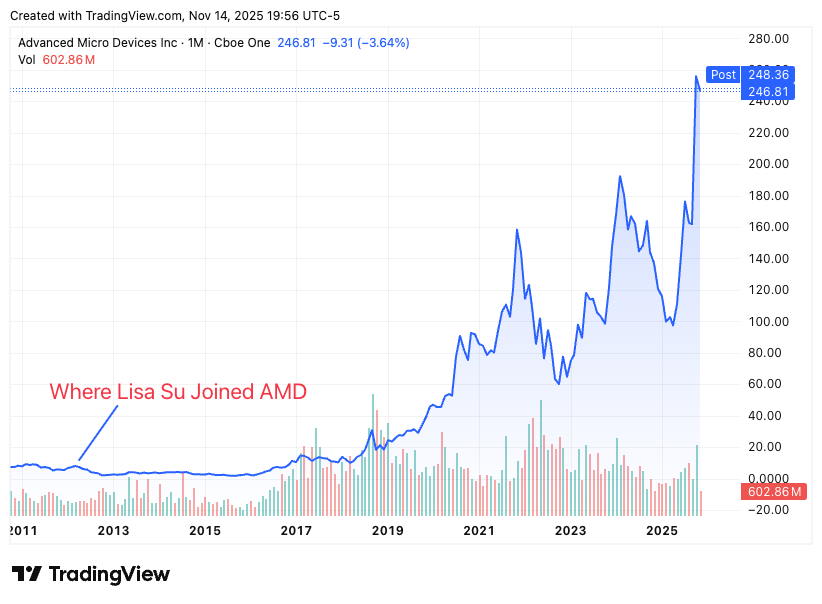
The scale of AMD’s financial and competitive transformation under Lisa Su is difficult to overstate. When she assumed leadership in 2014, AMD was valued at roughly US 2 billion, a distressed multiple reflecting fears of insolvency, declining relevance, and architectural stagnation. A decade later, AMD’s peak valuation exceeded US 250 billion, placing it among the world’s most strategically important semiconductor firms. This expansion was not a product of market optimism, but of a complete repositioning of AMD at the center of the global compute economy.
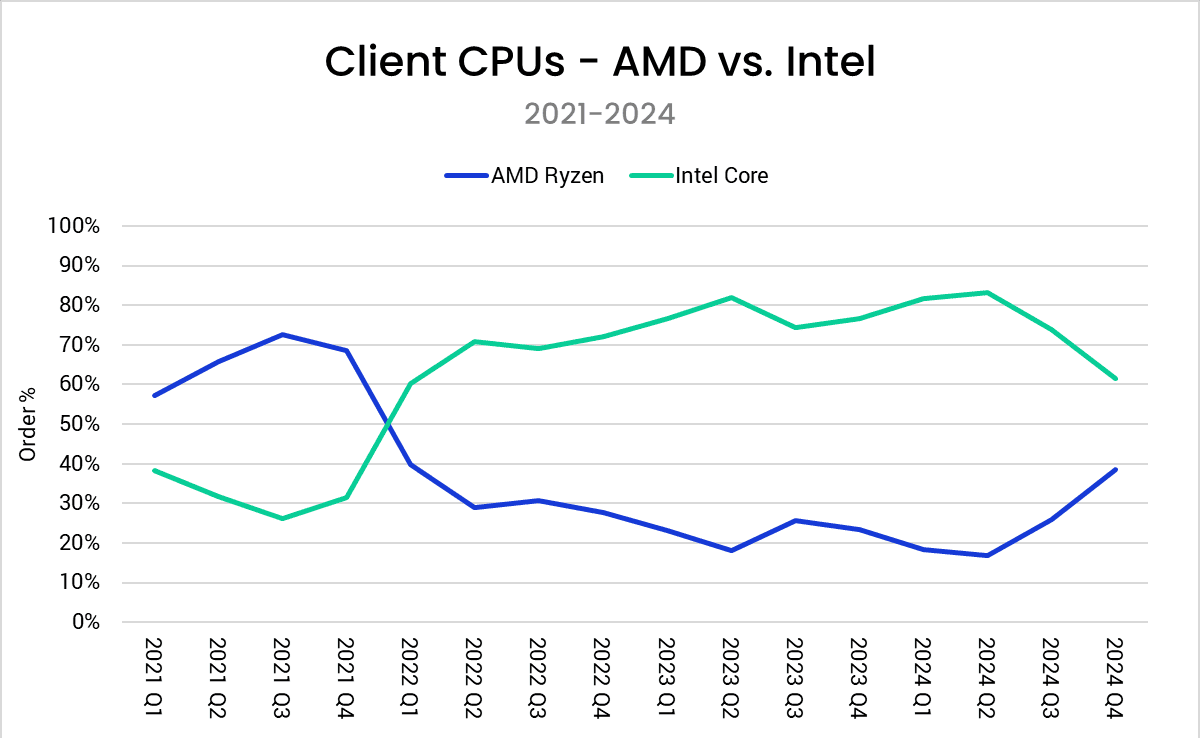
Market share recovery provides the clearest early signal of the turnaround. After years of contraction, AMD began regaining meaningful share in both client and server markets. In desktops, AMD’s x86 share rose from roughly 15 percent to more than 35 percent. The server segment was even more symbolic: from near irrelevance, AMD achieved over 30 percent penetration in hyperscale workloads. This shift fundamentally rebalanced the competitive landscape and established AMD as a structural counterweight to Intel in the data center. Institutions no longer viewed AMD as a tactical alternative; it became a strategic supplier embedded in cloud, enterprise, and HPC roadmaps.
Margin expansion reinforced this credibility. Gross margins improved from ~32 percent at the start of Su’s tenure to above 50 percent, a shift that rarely occurs in capital-intensive industries. This was driven by disciplined architectural choices, chiplet-driven cost efficiency, and a deliberate move into higher-value segments such as EPYC and adaptive computing. The move from subscale, low-margin PC components to high-performance, high-yield compute hardware altered AMD’s economic identity and validated Su’s long-term operating system.
Revenue growth tells the same story from a different angle. AMD scaled from US 5.5 billion in annual revenue to more than US 22 billion, with a far more resilient and diversified mix. What once was a cyclical consumer-PC dependent business evolved into a multi-vertical compute platform spanning CPUs, GPUs, data center accelerators, adaptive silicon, and embedded systems. The acquisition of Xilinx further accelerated this shift, adding a high-margin, mission-critical portfolio that solidified AMD’s role in automotive compute, telecom infrastructure, and aerospace applications.
The equity markets responded accordingly. AMD’s stock appreciated more than 2,000 percent during Su’s first decade — a generational performance for a large-cap turnaround. More importantly, institutional investors reclassified AMD from a speculative challenger to a core component of the AI compute and cloud infrastructure stack. Today, AMD is viewed as a credible competitor to both Intel in CPU performance and Nvidia in accelerator technologies, with a road map that positions it at the center of AI-era silicon demand.
In sum, the financial and market impact reflects a structural and durable transformation. AMD did not merely survive; it ascended into the highest tier of global semiconductor leadership, expanding its economic moat and aligning itself with the long-term trajectory of AI, high-performance compute, and adaptive silicon. Under Lisa Su, AMD became not a turnaround story, but a compounding engine.
6. Leadership & Culture — How Lisa Su Built a High-Integrity Organization
Lisa Su leads with a distinctive combination of engineering depth, execution discipline, and transparent communication—an operating model that defines both her leadership style and the cultural transformation at Advanced Micro Devices (AMD). Her approach fostered an environment of accountability and performance that underpinned the company’s turnaround.
Engineering Credibility and Technical Intimacy
Unlike many CEOs who delegate technical details, Su remains deeply engaged with architecture and product execution. In her guest lecture at Stanford Graduate School of Business, she reflected:
“I simply had a great curiosity about how things worked.”
This early curiosity translated into a leadership habit: returning to the lab, scrutinising chip prototypes, walking manufacturing lines. In a Time Magazine profile she was described as “going down to the lab to help scrutinise them”.
Such hands-on behaviour built credibility among engineers who had grown wary of missed execution cycles.
Culture of Rigour and Transparent Execution
Under Su’s leadership, AMD adopted new norms of review and accountability. She set bold, quantitative targets and ensured they were backed by measurable metrics and periodic review. In an interview she stated:
“People are really motivated by ambitious goals… the previous strategy of, ‘let’s just do a little bit better here and there,’ that’s actually less motivational.”
This orientation introduced a culture of high standards and clarified expectations. One profile noted:
“Her high expectations include sending late-night memos, holding morning discussions on complex topics, and personally overseeing lab operations—a level of engagement that sets a gruelling pace.”
Through these methods, Su molded an organisation that responded with urgency and technical discipline.
Reliable Capital Allocation & Decision Discipline
Within the culture Su shaped, every investment had to align with strategic intent and measurable outcomes. External commentary describes it as “Focus over flash: inside Lisa Su’s leadership execution playbook”.
Projects without strategic clarity were terminated; redundancies were removed; resources concentrated. This created a culture where discipline and execution rhythm became differentiators. AMD’s turnaround emerged not just from new chips, but from a consistent operating architecture of disciplined decision-making.
Communication, Trust & Stakeholder Alignment
Su’s leadership also emphasised transparent communication—both internally and externally. In her podcast discussion with the Committee for Economic Development she highlighted how planning for the unpredictable required clarity:
“We need to talk about unknowns.”
By engaging frontline engineers, partners, investors and customers with candid assessments, she aligned organisational incentives with long-term strategic design rather than short-term optics.
Building a High-Integrity Organisation
The combination of these behaviours—technical credibility, execution rigour, disciplined capital deployment, and honest communication—enabled AMD to rebuild cultural trust. Former employees and analysts consistently cite Su’s blend of engineer-CEO authenticity and operational leadership as the foundation for AMD’s renewed performance.
One analyst noted that under Su, AMD transformed from a reactive competitor into a deliberate, methodical one—a shift that traces directly to the culture she engineered.
In short, Su didn’t just turn around products or finances; she rebuilt an organisational system that could sustain high performance, high stakes and changing market dynamics.
7. Lessons for Thesis-Driven Investors
Lisa Su’s turnaround of AMD offers several enduring insights for investors who build portfolios around long-duration themes rather than short-term narratives. Her playbook demonstrates that structural compounding is fundamentally a product of discipline, capital efficiency, and leadership quality — not luck or tactical maneuvers.
The first lesson is that true transformation occurs on multi-year horizons. Su rebuilt AMD not in quarters but in cycles. The Zen program began years before it generated returns; the EPYC roadmap took time to earn trust from hyperscalers; and chiplet architecture required patience before the market rewarded it. For investors, this underscores the value of allocating capital to companies whose strategic direction is coherent, multi-year, and internally consistent. Structural value creation rarely appears instantly — it compounds when a clear plan is executed with conviction.
Another lesson is the primacy of capital allocation. Su inherited a company struggling under debt, fragmentation and stalled innovation. Instead of attempting to fix everything at once, she made deliberate, concentrated investments in the technologies that mattered most: Zen, RDNA, chiplets and adaptive computing. This mirrors a core principle in the Thesis Rationale framework: capital efficiency is strategy in its purest form. Management teams that prioritize focus over breadth tend to produce the most durable returns.
Leadership quality also plays a central role. Su’s style, technically fluent, operationally rigorous and transparent — created a culture where engineering excellence could take root. For investors, this reinforces the importance of selecting companies where management possesses both domain expertise and operating discipline. Exceptional leaders tend to produce exceptional trajectories, not because they try to do everything, but because they know what not to do.
Finally, AMD’s journey shows how market-share gains drive valuation expansion. Su did not rely on sentiment or financial engineering to push AMD forward. Instead, she built a product roadmap that steadily took share from competitors. When performance advantages are real and repeatable, the market eventually reprices the business. This is precisely the pattern that long-term, thesis-driven investors seek: structural advantage turning into financial compounding.
Taken together, Lisa Su’s turnaround is a reminder that the strongest investments are built on clarity of purpose, disciplined resource allocation, and leadership that compounds over time. For investors guided by durable thesis construction, AMD under Su stands as a blueprint for how operational excellence becomes long-term shareholder alpha.
8. Lessons for Operators & Founders
Lisa Su’s turnaround offers a rare blueprint for leaders facing complexity, resource constraints or competitive pressure. One of her most important insights is that focus itself is a strategy. Rather than spreading limited capital across multiple failing initiatives, she concentrated the entire organization around a few high-signal priorities. By exiting low-impact businesses and halting unproductive experiments, AMD recovered the financial and cognitive bandwidth required to rebuild its core. Founders often underestimate how much progress can be unlocked simply by eliminating noise.
Her leadership also demonstrates that culture change begins with technical credibility. Su did not rely on slogans or inspirational speeches; instead, she rebuilt trust through fluency in engineering and an insistence on substance over theater. Teams follow leaders who understand the work, challenge assumptions, and elevate technical standards. For operators, the takeaway is clear: credibility is earned through competence, not charisma.
The turnaround further shows that successful reinvention does not require complexity. AMD’s resurgence rested on a small number of clear, durable ideas — Zen for CPU leadership, chiplets for architectural scalability, EPYC for the data center. These ideas were simple to articulate and powerful to execute. Founders often chase too many initiatives; Su shows the opposite approach: identify a handful of transformative levers, align the entire company behind them, and execute relentlessly.
What stands out across Su’s tenure is that turnarounds are not magic. They are the cumulative result of clarity, discipline, and the willingness to make hard trade-offs. For operators and founders building through adversity, AMD offers one of the cleanest case studies of how focus, credibility, and simplicity can compound into one of the most impressive corporate revivals of the modern era.
9. Criticisms & Limitations
Even with one of the most impressive corporate turnarounds in the semiconductor industry, Lisa Su and AMD face constraints that are structural rather than managerial. The most formidable is Nvidia’s CUDA ecosystem, a software moated platform that is difficult to neutralize with hardware alone. AMD’s silicon may increasingly challenge Nvidia’s performance metrics, but without equal developer mindshare, software tooling, and enterprise integration, closing the AI-accelerator gap remains a multi-year challenge.
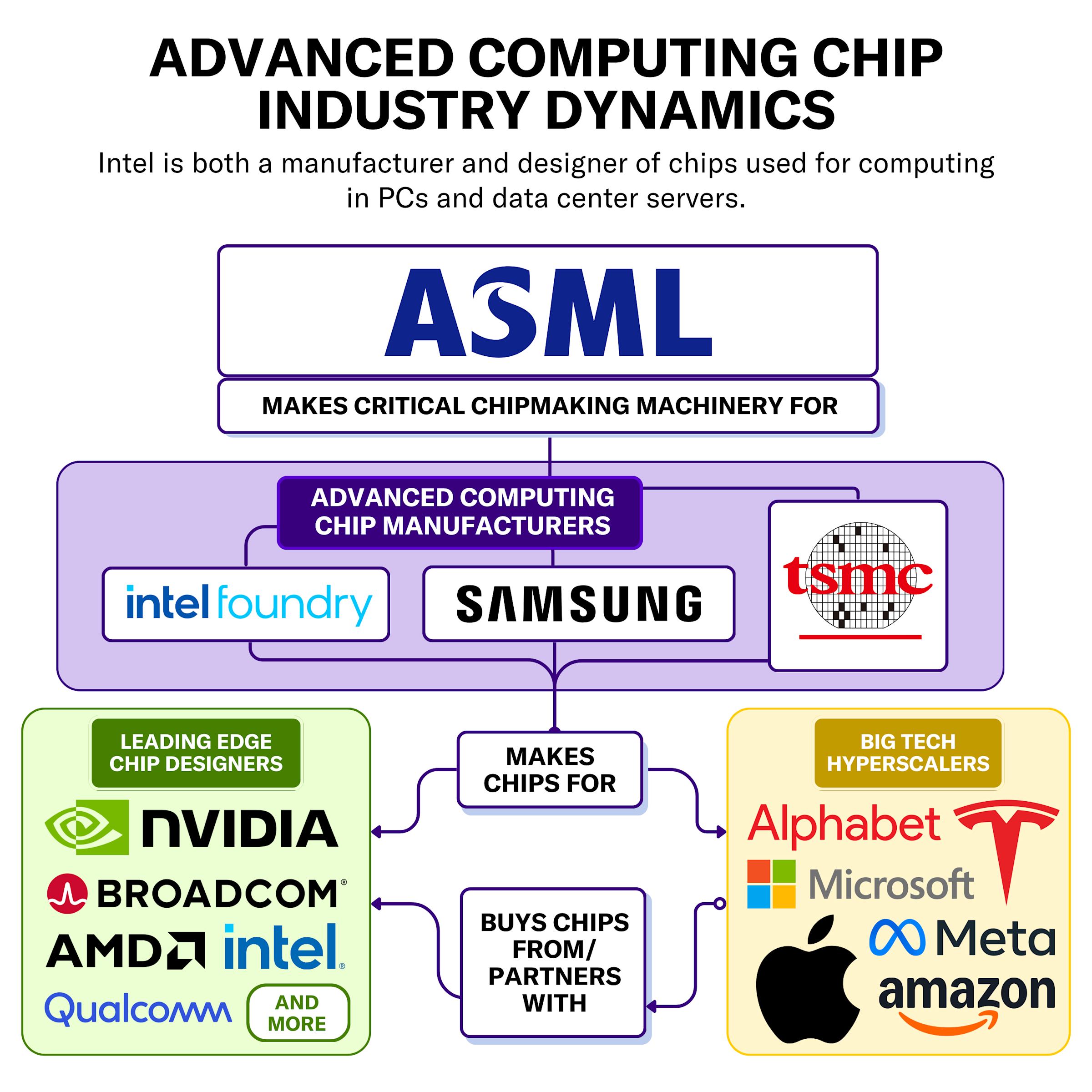
A second limitation is AMD’s reliance on TSMC as its sole advanced-node manufacturing partner. While this partnership has fueled AMD’s rise, it also introduces concentration risk. Su cannot fully control the cadence of foundry supply, pricing, or geopolitical exposure. In contrast, Intel and Nvidia maintain partially diversified manufacturing strategies, giving them different flexibility profiles.
Sustaining AMD’s performance trajectory also requires consistently high R&D intensity. Unlike consumer-tech companies that can coast on brand, AMD must continually out-innovate in architecture to justify its competitive position. This structural reality means that downturns in PC or GPU demand can tighten financial bandwidth just when future investment is most critical.
Finally, AMD operates in markets experienced in sharp cyclicality. Consumer GPUs in particular remain sensitive to inventory swings, gaming cycles, and macro sentiment. Investors should recognize that even with world-class leadership, the road ahead will oscillate between breakthrough years and digestion periods.
Su’s achievements are profound, but the competitive arena she plays in is unforgiving — and the constraints are largely exogenous.
10. Final Assessment — Why Lisa Su Is a Super CEO
Lisa Su’s stewardship of AMD stands as one of the defining corporate revivals of the century. She inherited a company on the verge of irrelevance and engineered a transformation that touched architecture, culture, capital allocation, and strategic identity. Her turnaround did not rely on cost-cutting, acquisition gimmicks, or financial engineering. Instead, it was anchored in first-principles engineering, long-term discipline, and a clear understanding of where the industry’s performance frontier was heading.
Under Su, AMD evolved from a distressed underdog into a core pillar of global compute infrastructure. The company now competes credibly across CPUs, GPUs, and accelerators, domains once thought permanently out of reach. Su’s impact places her in the same echelon as Satya Nadella at Microsoft, Jensen Huang at Nvidia, and the late Steve Jobs at Apple: leaders who did not merely optimize enterprises but fundamentally redefined their strategic trajectories.
What makes Su’s leadership exemplary is not just the scale of financial improvement, but the quality of the transformation. She brought order to fragmentation, coherence to chaos, and long-term direction to a business that had been governed by survival instincts. AMD’s resurgence is a working demonstration of how culture, technology, and disciplined capital allocation can compound into generational outcomes.
In the semiconductor age, where leadership rests on architecture, supply chains, and decades-long innovation cycles, Lisa Su proved that a great CEO can bend the fate of an entire company. Her decade at AMD is more than a turnaround. It is a case study in structural reinvention, and a template for any leader attempting to rebuild an organization from the edge of failure to the center of industry relevance.
At the recent earnings call, Su was asked about whether we are in an AI bubble.
Her response was not what I had expected.
In an effort to downplay the bubble theory, she stated that at times like these it is better to overspend than to underspend.
Does that not reinforce the bubble theory?
Is that not reckless for a CEO? How can she advocate overspending which implies a misallocation of shareholder capital?
Could this be her first major mis-step?
I welcome your views.
Hi Neural Foundry, Absolutely, this is a great point, and I fully agree with your framing.
The industry often talks about Zen’s IPC leap as the headline breakthrough, but the real structural unlock was chiplet modularity. It let AMD break free from the yield, cost, and scheduling bottlenecks that constrained monolithic designs for a decade. Once AMD shifted to a distributed architecture, iteration speed increased, binning economics improved, and performance scaling became fundamentally more predictable.
And you’re right about the TSMC dependency. People label it as a risk, but in practice it was a strategic liberation. Instead of being slowed by Intel’s in-house process delays, AMD plugged directly into TSMC’s leading-edge roadmaps, by getting access to 7nm, 5nm, and eventually 3nm ahead of most of the industry. That alignment allowed AMD’s architectural progress to compound without fabrication uncertainty dragging it backward.
In short: Zen made AMD competitive again, but chiplets + TSMC are what made the turnaround sustainable.
Thank you for your insight!